
B2B for food service is struggling with swings in supply cost, overall inflation and maintaining a steady cost of goods sold and a competitive price while protecting margins. It is a fluid macro and micro economic problem. They need the ability to instantaneously 'entangle' and pivot buying and pricing decisions based on point-in-time factors and directional trends.
The problem is most food service operators are managing buy-side and sell-side pricing as separate functions. The category manager is optimizing procurement. The revenue manager is setting prices. This leads to buying too much when demand is softening and later discounting to move the excess product. Or underpricing items that have a higher than forecasted COGS but strong demand.
The solution to this dilemma lay in pricing “Cogility,” linking moments of buying decisions with selling price.
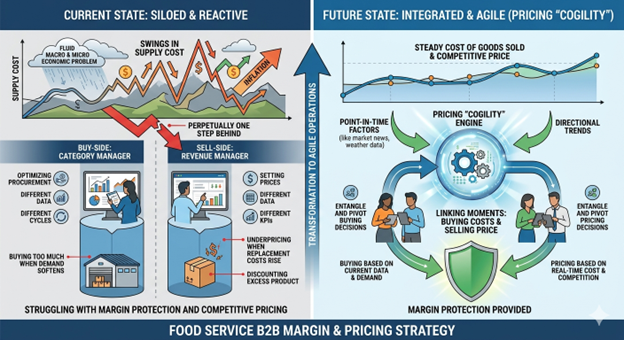 "Cogility" Pricing - Linking the Buying Moment to the Selling Moment
The Quantum Entanglement of Supply and Price
In traditional commerce, supply procurement and retail pricing exist in separate dimensions, linked only by lagging historical data. Agentic AI enables these two points to "entangle." In this state, a buying decision in procurement is no longer a static event; it is an instantaneous calculation of future price elasticity and margin integrity.
The Buy-Side: At the moment of procurement, an AI agent performs a real-time "margin stress test." While a high-volume supply buy might offer lower COGS, the agent recognizes softening demand signals in the periphery. It "sees" that overproduction will inevitably trigger aggressive discounting to clear stagnant or aging inventory. The agent autonomously opts for a lower-volume, higher-unit-cost buy because it protects the terminal margin. It prioritizes liquidity and price integrity over deceptive "paper" savings at the point of purchase.
The Sell-Side: Conversely, at the point of sale, the agent collapses the distance between cost and consumer. Because it has visibility into the COGS, current warehouse velocity, and predictive "likelihood-to-buy" scores, it can execute a more precise strike on pricing. If the inventory is aging and the replenishment cost has dropped, the agent can dynamically inject a discount that clears the unit while still locking in a pre-validated margin floor.
Margin Strategy is no longer a plan; it is an autonomous, real-time response to the entanglement of what we pay and what they’ll give.
The Architecture of Entanglement
Your architecture will need to progress from a "System of Record" to a "System of Agency” built to enable high-velocity decisioning:
- The Intelligence Core (SignalRadar): This layer utilizes machine learning-based signal detection to ingest fragmented data—from shifting supplier risk patterns to micro-fluctuations in consumer sentiment. It doesn't just report data; it predicts the aggregate directional impact of these signals in real-time.
- The Probabilistic Processor (Quantum Dice): Leveraging quantum-inspired probabilistic computing, this engine can simulate thousands of "what-if" margin scenarios simultaneously, optimizing based on likelihood and not a single forecast. It uses probabilities of sell-through, demand shifts, and discount risk to guide decisions.
- The Agentic Orchestrator: This is the operational layer. While the core computes, the AI Agents plan and execute. They operate within predefined safety guardrails, ensuring that autonomous actions—like rebalancing inventory or dynamic discounting—always align with broader corporate strategy and brand integrity.
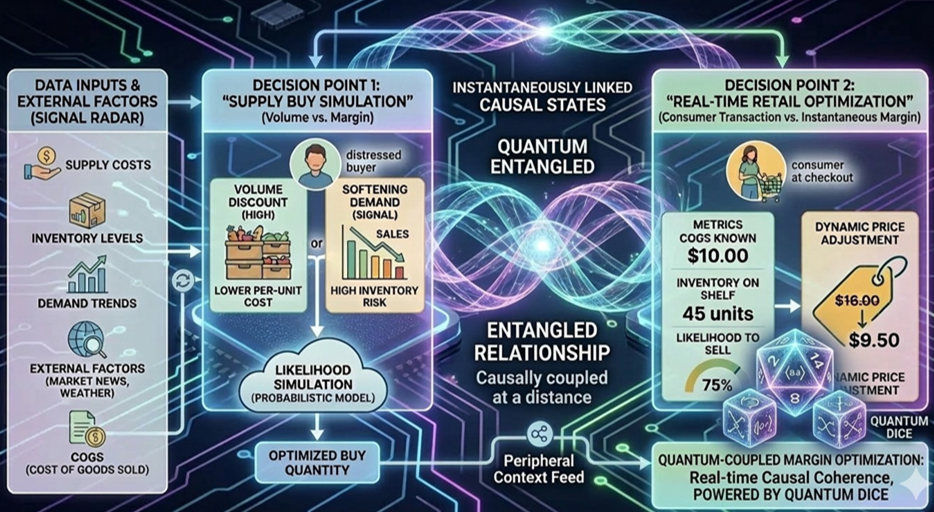 The Entangled Architecture
Agents and predictive models working together helps define Architecture as Strategy. By linking predictive signals directly to execution agents, the enterprise effectively collapses the lag between a market shift and a margin-protecting response.
The core insight of pricing “cogility” is this: the buy decision and the sell price are the same decision. The moment you treat them as separate functions, you have introduced a structural lag into your margin management. Closing that gap requires more than process improvement. It requires a unified data and modeling architecture that couples these two signals in real time and executes a simultaneous entangled optimization.