
Quantum Dice has announced the winners of the Trinity Challenge 2026, the second iteration of its use case challenge inviting innovators to develop solutions to real-world optimisation problems using probabilistic computing.
About the challenge
Sixty teams took part in this year's challenge, drawn from students, researchers and professionals. The challenge opened with an introductory session, followed by a reading week in which teams formed and worked through learning material on probabilistic computing and the classes of optimisation problem it can address. Each team then selected a use case from Quantum Dice's problem list.
An eight-week development period followed. Teams began with a proposal of how they planned to approach their chosen problem, followed by developing their initial formulation of the problem, before moving on to the implementation of their solution using Quantum Dice’s ORBIT™ simulator and developer tools.
ORBIT™ is Quantum Dice's probabilistic computing architecture, built on p-bits that fluctuate between states rather than holding a fixed value, and the challenge gives participants direct access to it alongside expert support from Quantum Dice’s researchers and engineers.
For many participants, the challenge was a first introduction to probabilistic computing.
Sheila Perez Garcia, Team P-bit and J, said: "We've both come from a quantum computing background, but neither of us had heard of probabilistic computing before, so the challenge seemed like a great opportunity to learn more and get hands-on experience."
Angus Mingare, Team P-bit and J, said: "The nice thing about the ORBIT™ simulator was that it had a very easy entry-level interface. You could provide the problem matrix, use the default parameters and run your first instance straight away."
Final pitches were assessed by an expert panel against criteria including innovation, technical quality, performance and real-world impact.
Meet the winners
First Place: Team P-bit and J
Angus Mingare and Sheila Perez Garcia
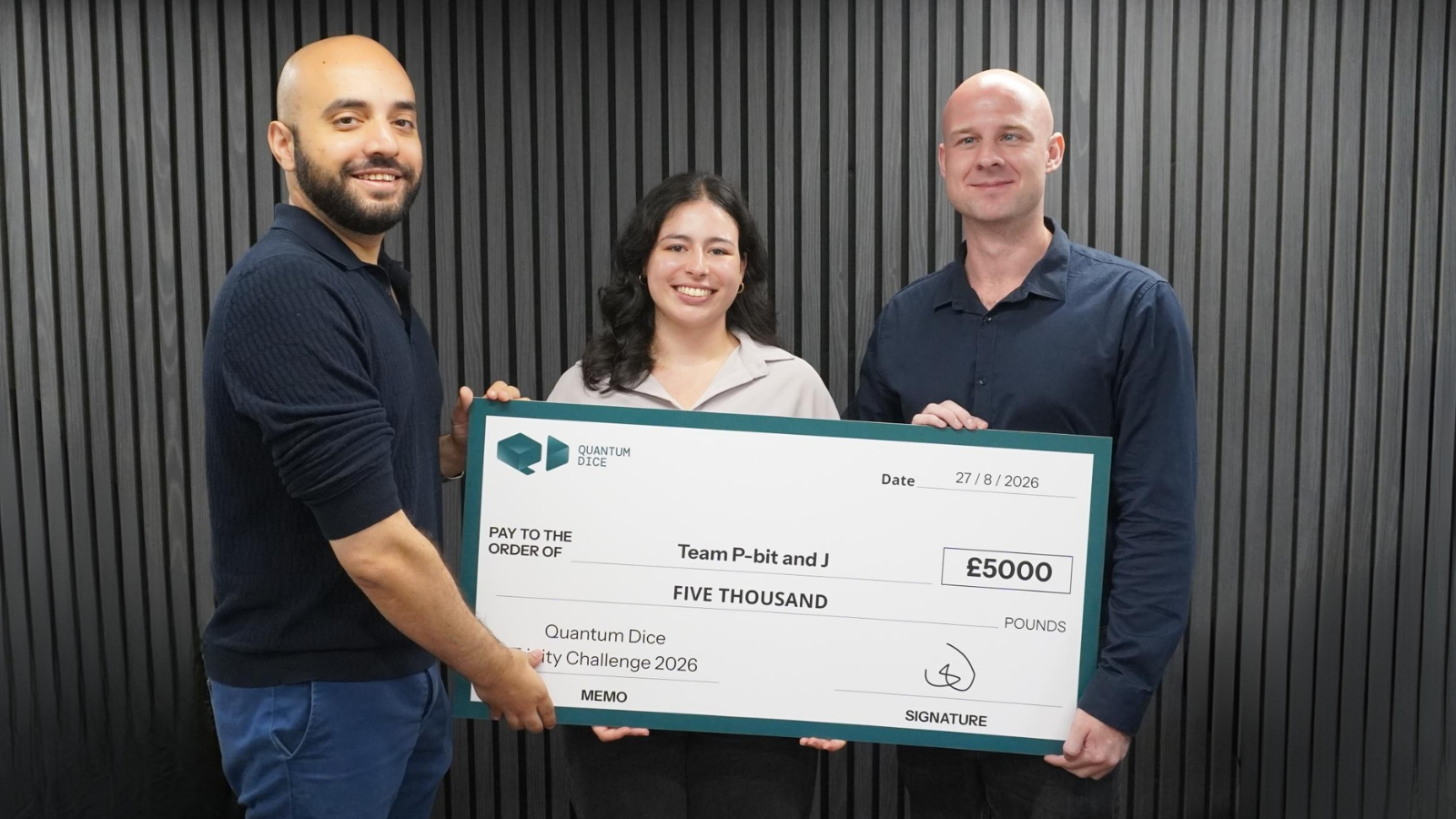
P-bit and J took first place with a solution focused on improving the resilience of electricity distribution networks. As renewable energy sources make power grids increasingly dynamic, network operators need better ways to identify parts of the grid that can continue operating independently during disruptions.
The team formulated the problem as a QUBO and solved it using the ORBIT™ simulator. Validated against exact solvers on real grid data, their approach identified resilient network "islands" that conventional clustering techniques failed to detect, with results indicating significantly reduced outage costs and potential for future hardware acceleration.
Second Place: Team Random Walker
Avdhoot Golekar
Second place was awarded for a solution addressing liquidity optimisation in real-time gross settlement systems. Queued payments can help banks reduce the liquidity tied up throughout the day, but identifying the optimal set of payments to settle is an NP-hard problem.
The solution encodes the optimisation objective and its constraints as a QUBO and uses ORBIT™ to sample near-optimal feasible configurations. The approach has the potential to increase settlement efficiency while reducing funding requirements.
Avdhoot Golekar, Team Random Walker, said: "The challenge was a great opportunity to learn something completely new. I didn't realise probabilistic computing could be applied to such a wide range of optimisation problems, and that was one of my biggest takeaways."
Third Place: Team Bona
Tinh Thanh Bui and Hoang Phi Yen Duong
Third place was awarded for a project exploring data routing in low-Earth-orbit satellite networks. As satellite constellations grow in scale, rapidly changing connectivity creates a difficult optimisation problem for routing data efficiently.
The team's solution combines probabilistic computing on the ORBIT™ platform with preprocessing and route-repair techniques to identify high-quality routing configurations. Results demonstrated improvements in latency, congestion and execution time compared with benchmark methods.
Tinh Thanh Bui, Team Bona, said: "One of the most interesting aspects for us was being able to compare different computing technologies on the same problem and better understand where probabilistic computing can offer advantages."
Quantum Dice would like to thank every team that took part in this year's Trinity Challenge. The challenge showcased the breadth of real-world challenges that probabilistic computing can tackle. Stay tuned for information about the next iteration of the challenge to find out how you can get involved.